
Community
WHEN SECONDS MATTER... WHAT WILL CLOSING REDDING FIRE STATION 3 MEAN FOR EMERGENCY RESPONSE?
Redding’s decision to close Fire Station 3 raises questions about emergency response across west and south Redding. With thousands of residents in the station’s service area, rising citywide call volumes, projected increases in response times, vegetation fire concerns and ongoing bridge projects affecting nearby roads, North State Now takes a closer look at what the closure could mean when seconds matter.
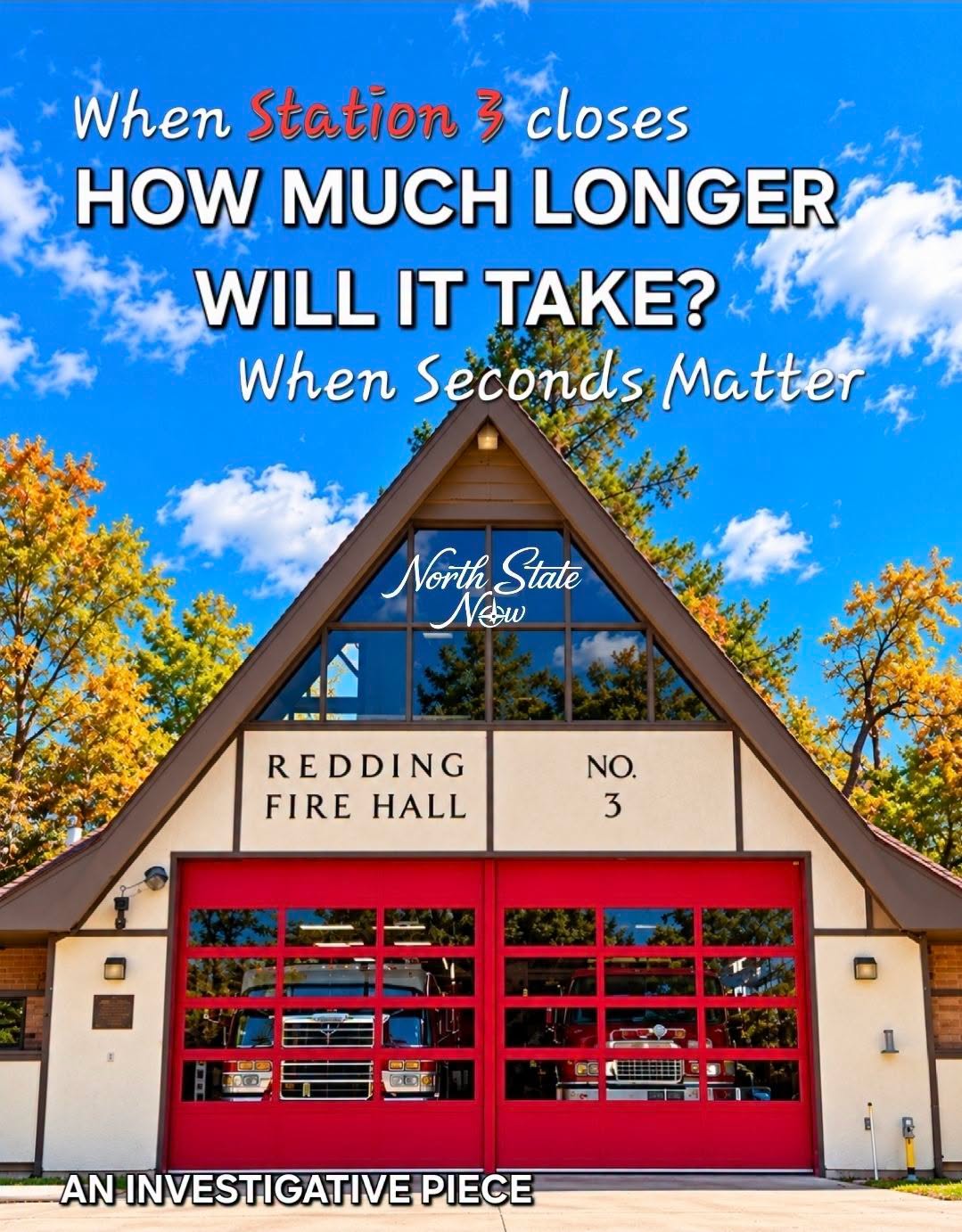
After a more than seven hour meeting Tuesday, the Redding City Council approved a series of budget reductions that include closing Fire Station 3 on Westside Road. I've spent some time looking beyond the initial announcement and into the City's own budgets, planning documents, wildfire plans and current road projects. I believe there's a bigger question here that deserves attention. What happens to emergency response when you remove a strategically located fire station from a heavily residential area where seconds can matter?
THIS ISN'T JUST ABOUT A BUILDING...
Redding currently operates eight strategically located fire stations. Station 3 has historically served an area of approximately 6.66 square miles containing around 7,464 residents and more than 4,300 structures. In 2021 alone, its district generated 1,519 calls for service.
The 2021 figure is the most recent publicly available number I could find specifically for Station 3, but more recent City budget numbers give us a better picture of the demand being placed on Redding Fire as a whole.
According to the City's current budget, Redding Fire recorded 14,916 calls for service in fiscal year 2023 to 2024. That number was estimated to reach 15,363 in 2024 to 2025, with 15,824 projected for 2025 to 2026 and 16,299 projected for 2026 to 2027.
The Fire Department itself currently says it has handled more than 16,000 emergency calls per year through its eight fire stations. That's important when discussing the closure of Station 3.
The calls coming from the neighborhoods Station 3 currently serves don't simply disappear when the station closes. Those medical emergencies, fires, vehicle collisions, rescues and other calls will still happen. The responsibility for responding to them will have to be absorbed by other available fire resources. And this isn't only about fires.
MOST FIRE DEPARTMENT CALLS ARE MEDICAL...
According to the City's own budget, roughly 70% of Redding Fire Department calls are EMS related. Redding firefighters are EMTs, and the City specifically says having strategically located fire stations provides shorter response times and allows firefighters to begin Basic Life Support before Advanced Life Support ambulance personnel arrive.
That could mean responding to someone suffering a heart attack or stroke.
Someone choking.
A serious vehicle collision.
A fall or other medical emergency.
A house fire.
Or a vegetation fire threatening a neighborhood.
These are situations where minutes, and sometimes seconds, matter.
RESPONSE TIMES WERE ALREADY PROJECTED TO INCREASE...
According to Redding's adopted budget, the City's average first unit emergency response time was 4 minutes and 38 seconds in fiscal year 2023 to 2024. It was estimated at 4 minutes and 58 seconds for 2024 to 2025 and projected to reach 5 minutes and 8 seconds in 2025 to 2026 and 5 minutes and 18 seconds in 2026 to 2027.
That's a projected increase of about 40 seconds over three years.
Those projections were made before this week's decision to close Station 3.
What I have not been able to find publicly is something particularly important:
What will the projected response time be specifically for the neighborhoods currently served by Station 3 once that station closes?
THEN THERE'S THE VEGETATION FIRE RISK...
This is something many residents of west and south Redding are already familiar with.
The Station 3 area includes heavily residential neighborhoods alongside areas of grass, brush, open vegetation and undeveloped land. And this year I've personally noticed something encouraging. Time after time, vegetation fires around Redding have seemingly been hit quickly and stopped before becoming much larger incidents.
There are documented examples.
A September vegetation fire near the Sundial Bridge was held to approximately 4.65 acres despite north winds reportedly producing spot fires.
Another near College View Drive was contained at approximately three acres about 20 minutes after the first engine arrived.
And the Linden Fire in June threatened structures and prompted evacuations before firefighters ultimately stopped it at approximately 15 acres.
I haven't found enough complete year to year data to say that 2026 has statistically been Redding's best year for vegetation fire response. But many residents this year have reportedly noticed how quickly firefighters have responded to and stopped vegetation fires that had the potential to quickly grow out of control.
After seeing what appears to be significant progress in getting these fires stopped quickly, it raises another question:
Could closing Station 3 be a step backwards?
Redding has intentionally invested heavily in wildfire readiness, including additional firefighter staffing and extensive vegetation management specifically intended to improve wildfire prevention and response. For a community that has lived through the Carr Fire, the ability to hit a vegetation fire quickly isn't something residents take lightly.
AND RIGHT NOW, ACCESS IN SOUTH REDDING IS ALREADY COMPLICATED...
There are also two major bridge projects affecting this general part of Redding.
The Westside Road bridge at Canyon Hollow Creek is currently under construction near Station 3. That section of Westside Road is completely closed, and according to the City, even emergency vehicles cannot travel through the construction zone and must detour. The current full closure is scheduled through November 16, although the overall bridge project has been anticipated to continue into 2027.
Then there's Eastside Road at Olney Creek. Construction on that bridge began in 2023 and, more than three years later, work remains underway.
Eastside Road has been reduced to alternating one lane traffic through the construction area. Emergency vehicles are given immediate passage, but it remains another restricted transportation corridor in south Redding.
The Olney Creek project also provides an important reminder that construction projects don't always proceed exactly according to their original timelines. That project encountered unforeseen issues, including contaminated soil, that contributed to additional costs and extended work.
That doesn't mean the same thing will happen on Westside Road. But it does mean current completion schedules aren't guarantees.
So as Station 3 closes, this portion of Redding is already dealing with road restrictions that can affect how vehicles move through the area.
AND THAT LEADS BACK TO ONE SIMPLE QUESTION...
Closing Station 3 doesn't mean Redding suddenly stops providing emergency services to these neighborhoods.
Other Redding fire stations will respond. Dispatchers can use alternate routes. CAL FIRE and Shasta County Fire also have mutual and automatic aid relationships with Redding.
And city leaders are dealing with very real budget problems.
Mayor Mike Littau has also pointed out that Station 3 was closed for years in the past before additional funding allowed it to reopen.
That's important context.
But Redding has changed.
Call volumes have changed.
Wildfire concerns have changed.
Traffic and development have changed.
And according to the City's own projections, emergency response times were already trending upward before this latest decision.
So this isn't about predicting catastrophe or claiming that closing Station 3 will automatically result in a specific delay.
It's about asking a question that I believe residents currently served by Station 3 deserve an answer to:
When someone calls 911 after Station 3 closes, how much longer, if at all, will they wait for that first fire engine to arrive?
Because whether it's a vegetation fire moving toward homes, a house filling with smoke, a serious crash or someone experiencing a life threatening medical emergency...
Seconds matter.
Story By North State Now